

Wancher sells hand-lacquered Japanese urushi dials in ordinary steel cases, from $370 to $3,000. This review covers what the lacquer actually is, which movements sit behind it, and exactly what the extra $1,275 buys between the cheapest Dream Watch and the most expensive one.
Is a Wancher watch worth buying?
Wancher is worth buying for the dial, and for very little else. The lacquer work is real Japanese urushi from named workshops. The case, the crystal and the movement are ordinary parts shared across the whole range, which means the gap between a $425 Wancher and a $1,700 Wancher is almost entirely artwork. That is either the best value in the category or a bad joke, depending on why you want the watch.
Check current Dream Watch prices
Disclosure: some links on this page are affiliate links. If you buy through them we may earn a commission at no extra cost to you. Wancher’s public affiliate program pays partners 15% of the sale, which is worth knowing when you read any Wancher review, including this one.
What Wancher is and isn’t
Wancher is a small Japanese company best known for fountain pens, not a Swiss maison and not a manufacture. It was founded by Taizo Okagaki, whose interest in timekeeping reportedly started while he was working in Egypt during the Gulf War in the 1990s. The company’s international reputation was built on the Dream Pen line of urushi-lacquered fountain pens, and the watches came later.
The Dream Watch collection that people actually buy today only started in 2021, launched on the Japanese crowdfunding platform Makuake before going worldwide. That date matters, because most of the older criticism you will find about Wancher on watch forums predates it and refers to a different catalogue of generic dive and pilot watches. Wancher’s own company page is unusually blunt about that earlier era, describing those designs as unoriginal and lacking any identity or story of their own.
The part buyers most often get wrong is assembly. Wancher does not make everything in one place. Depending on the model, assembly happens in Oita and Bungotakada in Japan or in China, with the Dream Watch line built in Japan and the Kaguya assembled offshore according to reviewer WatchDad. Quality control is run in Japan, and Wancher publishes its own timeline for it: three days of handling per watch, plus roughly five extra days of pre-shipment checking for mechanical movements. “Made in Japan” is doing narrower work here than the marketing suggests, and if that distinction matters to you, ask before you order rather than after.
Real urushi, and how to tell
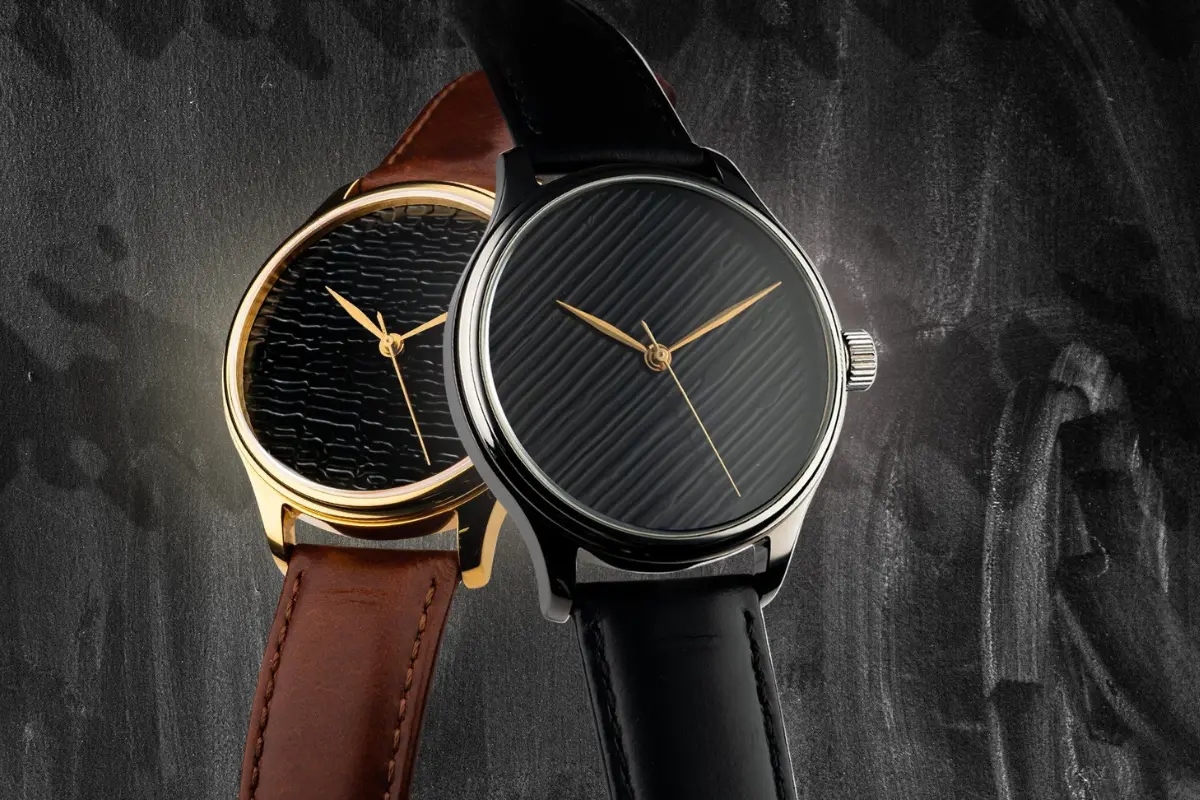
The lacquer is genuine, and that is the single claim Wancher backs up best. Dream Watch dials use tennen urushi, natural Japanese lacquer harvested as tree sap, applied in thin layers that cure under controlled humidity. Wancher states a single dial takes four to six months across multiple stages, and credits named workshops rather than an anonymous factory: Taya Shikkiten in Wajima, artisans in Echizen, charcoal urushi from Oita.
The distinction that costs people money is between a lacquered dial and a decorated one. Traditional maki-e, where gold powder is sprinkled into wet lacquer by hand, takes months to a year per piece using brushes with as few as three to five hairs. That is the Dream Dragon at $3,000, and the price is not arbitrary. Wancher’s cheaper decorated models use kindai maki-e, a modern hybrid: the urushi base is still hand-lacquered, but the design itself is applied by a high-quality silk-screen process and then finished with real metal powder to restore the shimmer. WatchDad, whose hands-on look at the Aka Fuji traces the process, describes it as sitting between hand-painted art and an ordinary printed dial.
Neither approach is dishonest, but the product pages do not separate them clearly, so read the dial description before deciding what you are paying for.
One inconsistency worth knowing: the Kuro Muji specification table lists its dial as Echizen nuri while the description on the same page credits the Wajima workshop. That kind of sloppiness recurs across the catalogue and is worth an email before you order.
The movement question
Wancher runs two engines: the Japanese Miyota 9015 in the Dream Watch line, and the Chinese Hangzhou H7M01 in the Kaguya moonphase. Nothing in this range is in-house, and nothing needs to be at these prices, but the difference is worth understanding because it is the clearest signal of where Wancher spends money.
The Miyota 9015 is a well-known automatic: 24 jewels, 28,800 vph, 42-hour power reserve, hacking and hand-winding. Wancher’s own specification sheets rate it conservatively at minus 10 to plus 30 seconds per day with a positional variance under 40 seconds, which is Miyota’s factory tolerance rather than a regulated figure. WatchDad reported roughly minus 10 to plus 15 seconds per day on his Aka Fuji sample. Either way, this is a movement you can get serviced by any competent watchmaker anywhere, which matters more than it sounds for a brand with no overseas service network.
The Kaguya uses the Hangzhou Watch Factory H7M01, a seventh-generation Chinese in-house caliber with a 48-hour reserve at the same 28,800 bph. Wancher’s numbers for it do not agree with themselves: the specification table on the Kaguya product page states plus or minus 15 seconds per day, while the marketing copy further down the same page claims plus or minus 2 to 10 seconds. WatchDad reported his regulated to 2 to 3 seconds a day and said plainly he would have preferred a Japanese movement in it. Treat the tighter figure as best case, not as a specification.
Here is the part that decides most purchases. The $425 Kuro Muji and the $1,700 Raden carry the identical Miyota 9015, the identical 42mm by 12mm steel case, the identical domed sapphire, the same 68g weight, the same 20mm lugs and the same 5 ATM rating. The $1,275 between them buys dial art and nothing mechanical at all.
Dream Watch lineup, priced
Prices below are Wancher’s own list prices as of July 2026 and move with new releases and sell-outs, so check before ordering. Several of the most attractive dials sit permanently out of stock or on backorder, which is a real constraint rather than manufactured scarcity: a dial that takes four to six months to make cannot be restocked quickly.
| Model | Dial | Movement | Price (July 2026) |
|---|---|---|---|
| Dream Moonphase Kaguya | Dyed mother-of-pearl raden | Hangzhou H7M01 | $370 |
| Dream Watch Kuro Muji | Plain black urushi | Miyota 9015 | $425 |
| Dream Watch Urushi Blue, Purple, Green | Coloured urushi | Miyota 9015 | $470 |
| Dream Watch Byakudan-nuri | Layered translucent urushi | Miyota 9015 | $550 |
| Dream Watch 24K Kinpaku Maki-e | Gold leaf over urushi | Miyota 9015 | $650 |
| Dream Watch Hirota Hibi Nuri | Cracked-shell urushi | Miyota 9015 | $700 |
| Dream Watch Chawan-Iro series | Textured kinma urushi | Miyota 9015 | $800 |
| Dream Watch Kawari Nuri | Wajima urushi, lacquered case | Miyota 9015 | from $850 |
| Dream Watch Raden | Echizen raden maki-e | Miyota 9015 | $1,700 |
| Dream Dragon Maki-e | Hand-painted maki-e | Miyota 9015 | $3,000 |
For a first Wancher, the sensible entries are Kuro Muji at $425 if you want plain lacquer that reads as a normal dress watch from a metre away, or one of the $470 colours if you want people to notice. Byakudan-nuri at $550 is where the lacquer starts doing something a printed dial cannot imitate, shifting colour as it catches light. Above roughly $800 you are buying art, and you should want that specific dial rather than an upgrade. If the entry models sit just outside your budget, it is worth checking whether you can see if a code brings it under $500 before you add shipping and duty on top.
Kaguya Moonphase: mother-of-pearl and a 31-day complication
The Kaguya is the odd one out, and two things about it are commonly misread. It has no urushi at all: the dial is dyed mother-of-pearl, which is why it shifts between blue and purple depending on angle, and why it costs $370 rather than $500 and up. And the moonphase is not a moonphase. As WatchDad puts it, the subdial at ten o’clock is a modified date display running a 31-day cycle with a painted moon on the disc, not an astronomical complication tracking the real 29.5-day lunar month.
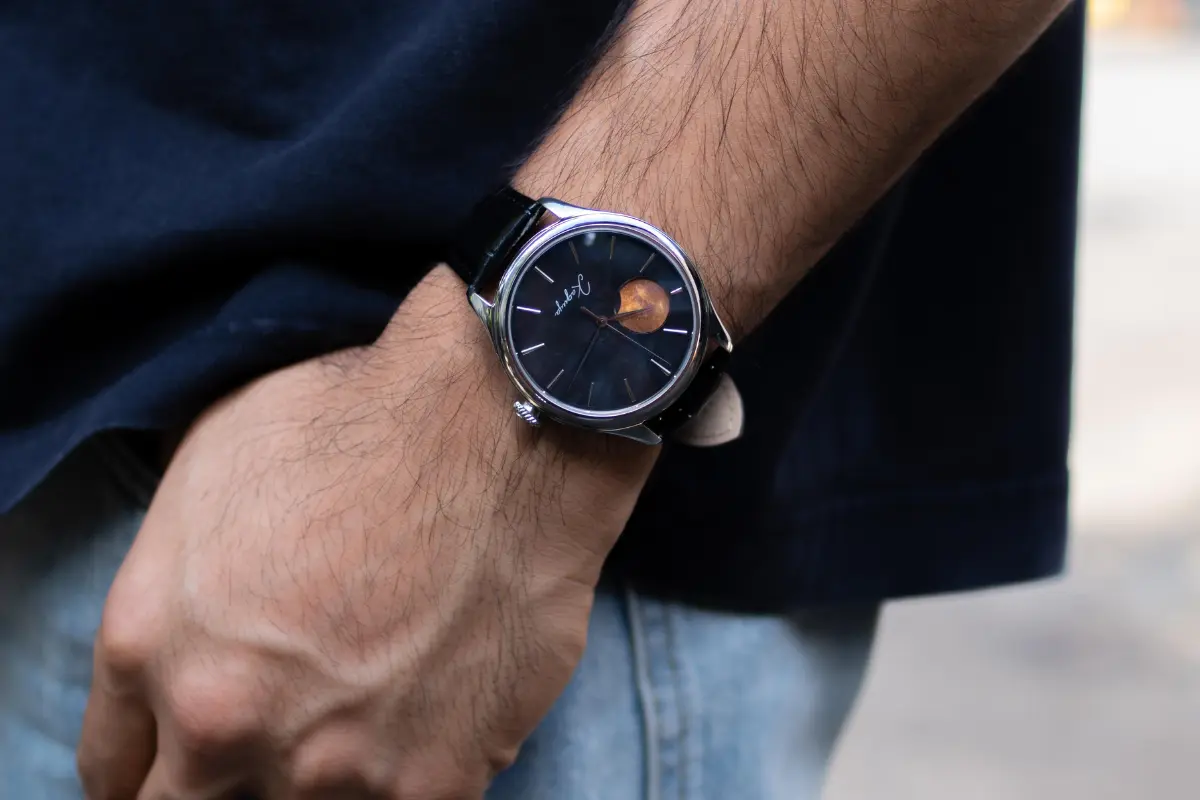
That sounds damning written down and mostly isn’t in practice. It is decorative, well executed, and at $370 nobody was getting a true moonphase anyway. What you should not do is buy it expecting a complication you can explain to another collector without an asterisk.
Specifications are 42mm across, 12mm thick, 48mm lug to lug, 316L polished steel, sapphire with anti-reflective coating on both faces, a clear caseback and an Italian cowhide strap.
Note the 21mm lug width. That is an awkward size, and replacement straps in 21mm are meaningfully harder to find than 20mm or 22mm, so factor a strap hunt into ownership.
On the wrist
The Dream Watch wears like a 42mm dress watch that forgot dress watches are usually smaller. The case is 42mm across and 12mm thick at 68g, with 20mm lugs and a cowhide or galuchat strap on a plain buckle. There is no bezel and no lume, which suits the intent but leaves the watch unreadable in a dark restaurant.
Sizing is more forgiving than the diameter suggests because the lug-to-lug measurement is modest: 48mm on the Kaguya and around 50mm on the Aka Fuji. WatchDad, who wears a 17cm wrist, found both comfortable. Wancher’s own specification sheets quote a 22cm arm circumference for strap length, so smaller wrists will have plenty of adjustment while larger ones should check the number before ordering.
Water resistance is the one specification to read carefully. Dream Watch pages state 5 ATM and add that this applies in a stationary state only, and WatchDad noted the Aka Fuji case is physically marked 100m while the watch is officially rated 50m. Treat any Wancher as splash-resistant and nothing more. A hand-lacquered dial behind a domed crystal is not something to test in a pool.
What owners say after 6+ months
Long-term independent ownership reporting on the Dream Watch line is thin, and pretending otherwise would be dishonest. The collection is only a few years old, most published reviews are written within weeks of receiving the watch, and we found no Trustpilot profile for Wancher’s watch business. Anyone claiming a consensus on how these age is guessing.
What does exist is consistent in shape. Reviewers who have lived with the watches describe the dial as the thing that keeps rewarding attention months later, and the rest of the watch as unremarkable in the way a Miyota-powered steel case is always unremarkable. WatchDad, who has covered several Wancher models and discloses a partner discount code, praised the Kaguya’s dial in strong terms while flagging the Chinese movement as his main reservation. Ratings on enthusiast databases sit around 4.1 out of 5 from a very small sample.
Ratings on Wancher’s own product pages are worth treating carefully, because they are self-hosted and the sample sizes are tiny. Some models show 5.0, others show 1.0, and a single unhappy buyer can produce either. The older criticism that circulates about Wancher is worth reading in context too: a 2020 review of the discontinued Seaserpent found a Seiko NH35 running roughly 30 seconds fast per day and called it poor quality control, and a 2018 forum thread argued the brand was effectively a Chinese OEM operation with a Japanese address. Both predate the Dream Watch line by years and describe a different product.
Where Wancher falls short
Service is the real weakness. Wancher’s warranty covers one year from purchase, and the entire process runs through a single web form and a Japanese email address. No regional service centres, no authorised repairers in North America or Europe, no published turnaround time. If your watch fails in month eleven you are shipping it to Japan and waiting. The saving grace is the Miyota 9015, which any independent watchmaker can service without factory parts, but that only helps after the warranty has expired and it does not help at all with a damaged lacquer dial.
Returns are advertised as a 30-day guarantee and are less generous than that headline. Wancher deducts the original shipping cost plus a 10% restocking fee on anything returned for preference rather than defect, and the watch must come back unworn in original packaging. On a $700 watch that is a meaningful cost for changing your mind.
Shipping and duty are also on you. Wancher ships from Japan, declares parcels at full order value, and states plainly that import charges are the buyer’s responsibility. Wancher’s site also notes that free shipping is not available to the US in 2026. Any duty or VAT figure you see quoted online is an estimate that depends on your country’s own thresholds, so check your national customs guidance rather than trusting a number in a blog post.
Then there is the housekeeping. Accuracy figures contradict each other on the same product page, a case is marked with one water resistance rating and sold with another, dial provenance is listed as Echizen in one place and Wajima in another, and handling times differ between products with no explanation. None of these is a scandal. Together they suggest a small team moving faster than its documentation, which is exactly what Wancher is.
Who should buy, and who shouldn’t
Buy one if
Buy a Wancher if you want a genuinely hand-lacquered Japanese dial and cannot justify the Seiko Presage urushi models, which start well above $1,000 on the secondary market. Buy one if you already own the mechanical watches you need and want something that looks different in a collection. Buy one if you find a specific dial you keep coming back to, because that is the only part of this watch that is scarce.
Skip it if
Do not buy a Wancher as your only watch, as a daily beater, or as anything you plan to swim, garden or work in. Do not buy one expecting Swiss finishing, local warranty support or a fast repair path, and do not buy one as an investment: microbrand resale is unpredictable and lacquer condition is unforgiving. If you want a moonphase that tracks the moon, the Kaguya is not it.
Verdict and price check
Our rating: 3.5 out of 5. Wancher delivers exactly one thing at a level nobody else matches at the price, and is average or below average at everything surrounding it. Judged as a lacquer dial with a watch attached, it is excellent value. Judged as a watch, it is a Miyota 9015 in a plain steel case for between $370 and $1,700.
On price, buying direct wins clearly, which is not the usual outcome. Marketplace resellers based in Japan list the same models well above Wancher’s own prices, as the check below shows. The listings are worth reading anyway, since some include prepaid import fees, and older or limited variants occasionally appear there that Wancher no longer sells.
| Model | Wancher direct | eBay Japan reseller | Cheaper option |
|---|---|---|---|
| Kaguya Murasaki Blue | $370 plus shipping | $449 plus $59 shipping | Direct |
| Hirota Hibi Nuri | $700 plus shipping | $1,100 plus $25, duty prepaid | Direct |
Reseller prices checked July 2026 and change constantly; eBay listings may cover earlier generations of the same model, so compare the movement and dial description rather than the model name alone. Buying direct through Wancher’s own Dream Watch collection also keeps the 30-day return window and the one-year warranty, both of which you lose or complicate through a third party. If you are ordering from Wancher, it is worth a minute to look at current Wancher discount codes before you check out, since the shipping and duty on a Japanese parcel will eat any small saving you find elsewhere.
Frequently asked questions
Are Wancher urushi dials real lacquer?
Yes. Wancher states that Dream Watch dials use tennen urushi, natural Japanese lacquer, applied in layers over four to six months by workshops it names, including Taya Shikkiten in Wajima and artisans in Echizen. The distinction to watch is decoration rather than the lacquer itself: hand-painted maki-e is genuinely hand-drawn, while the cheaper kindai maki-e models use a silk-screened design over a real urushi base, finished with metal powder.
What movement does a Wancher watch use?
The Dream Watch line uses the Japanese Miyota 9015 automatic, with 24 jewels, 28,800 vph and a 42-hour power reserve. The Dream Moonphase Kaguya uses the Chinese Hangzhou H7M01, a seventh-generation in-house caliber with a 48-hour power reserve at the same beat rate. Neither is made by Wancher, and both are serviceable by independent watchmakers.
Is Wancher actually made in Japan?
Partly. Wancher is a Japanese company and its urushi dials are lacquered in Japan by named workshops. Assembly depends on the model: reviewer WatchDad reports the Dream Watch line is assembled in Japan while the Kaguya is assembled offshore. Wancher carries out its quality control in Japan, quoting three days of handling per watch plus around five additional days of testing for mechanical movements.
Does urushi lacquer fade or scratch?
Cured urushi is hard and resists water and everyday abrasion well, but it is genuinely sensitive to light. Research published in the Journal of Wood Science in 2023 describes urushi as deteriorating under light exposure, with fading and loss of gloss over time. On a watch the dial sits under sapphire rather than in a display cabinet, which helps, but long daily sun exposure is still the main risk to a lacquered dial.
How accurate is a Wancher automatic?
Wancher rates the Miyota 9015 models at minus 10 to plus 30 seconds per day with positional variance under 40 seconds, which is the factory tolerance rather than a regulated figure. For the Kaguya, Wancher’s specification table states plus or minus 15 seconds per day while its marketing copy on the same page claims plus or minus 2 to 10 seconds. Independent reports have landed inside the tighter range, but the conservative number is the one to plan around.
Does the Dream Watch fit a small wrist?
Usually, yes. The case is 42mm in diameter and 12mm thick, which sounds large, but the lug-to-lug measurement is only around 48mm to 50mm and the watch weighs roughly 68g. Reviewer WatchDad wears a 17cm wrist and found both the Kaguya and the Aka Fuji comfortable. Wancher’s strap specifications quote a 22cm maximum arm circumference, so check that figure if your wrist is at the larger end.
Does Wancher ever discount its watches?
Wancher runs a public affiliate programme paying 15% commission, and partner reviewers are sometimes issued reader discount codes, so promotional pricing does circulate outside the official site. Wancher also runs seasonal and final-stock promotions directly. Because these change frequently and expire without notice, it is worth checking current offers and other ways to pay less on a Dream Watch before ordering rather than relying on a code you saw in an older review.